
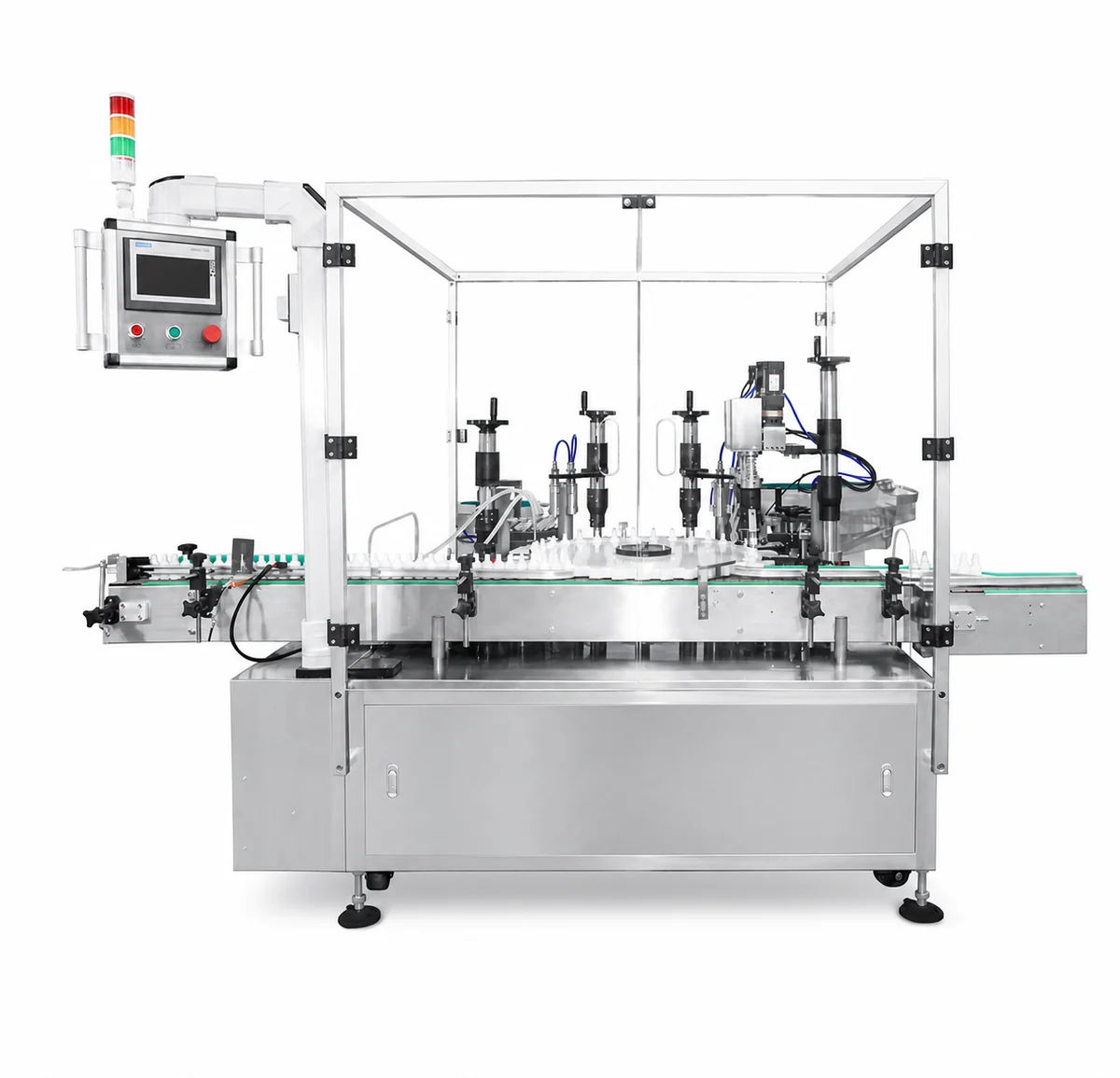
A monoblock can place filling, plug insertion and capping stations on one compact platform, but “one machine handles all bottles” is not a complete engineering answer. Every container must remain controlled as it enters, stops under a station, transfers between operations and leaves the machine.
1. What Are Monoblock Change Parts?
Change parts are package-specific components used to guide, locate, transfer or process a confirmed format. On a filling and capping monoblock, they may include bottle guides, holders, pucks, star wheels, an infeed screw, neck guides, filling locators, plug insertion tools, cap chucks and sensor brackets. The exact list depends on the machine structure.
Some machines use adjustable rails and holders instead of a dedicated star wheel. Others use star-wheel or indexed-pocket transfer. The quotation should describe the actual configured mechanism rather than assuming that every monoblock uses the same set of parts.
This guide is narrower than the general capping machine changeover checklist. It focuses on defining and buying the physical parts needed by an integrated format, not on resetting a capper that already has approved tooling.
2. Build a Bottle, Plug and Cap Format Matrix
Use one row for each production SKU family. Two bottles that share a nominal volume can need different parts if the diameter, neck height, shoulder, base or stability changes. Two caps with the same nominal thread can also require different feeding or gripping tools.
| Format field | What the buyer provides | What the supplier confirms |
|---|---|---|
| Product and dose | Liquid behavior, fill volume, temperature and acceptable result. | Filling method, product-contact path, nozzle position and the representative test condition. |
| Bottle | Drawing or measurements, material, height, diameter, neck, base and filled weight. | Guide, holder, puck, star-wheel or other control method and whether a dedicated part is required. |
| Inner component | Plug, dropper, insert or seal geometry and fit requirement. | Feed, pick, insertion and seating tools plus the agreed inspection result. |
| Outer closure | Cap, pump, sprayer or other closure with tube and liner when present. | Sorting, transfer, placement, tightening or pressing tooling and orientation control. |
| Output condition | Required accepted bottles per minute or per shift and expected change frequency. | Sustained test condition, operator tasks, replenishment and known format limits. |
| Acceptance | Fill, seating, torque, seal, leak and appearance checks required for the package. | Sample method, test duration, records, deviations and retest responsibility. |
The container, closure and product checklist helps collect the information needed before tooling is released. Physical components should be requested when drawings and photos are not enough to confirm fit or factory testing.
3. Confirm the Complete Bottle-Handling Path
Infeed and spacing
The bottle must enter at a repeatable pitch without falling, scuffing or pushing the next container into the station. Where the configured machine uses an infeed screw or indexed pocket, check the bottle diameter, height, shoulder and filled stability against that part.
Star wheel, holder or puck
The locating component should control the bottle without excessive squeeze, free rotation or neck deflection. A dedicated star wheel is not automatically required for every diameter, but a format cannot be approved until the supplier states what controls it and demonstrates that method.
Station alignment
The bottle center must agree with the filling nozzle, insertion tool and capping axis. A bottle can travel smoothly and still be wrong for the process if the neck arrives off-center or changes height under load.
Discharge and downstream transfer
Check that the finished bottle leaves without contact that loosens the closure, damages a long pump tube or destabilizes a tall narrow container. If the monoblock feeds a labeler or collection table, include that handoff in the test.
4. Confirm Inner-Plug and Cap Tooling Separately
An integrated machine may perform several closure operations, but each operation has its own interface. Do not group them under one line item called “capping parts.”
| Operation | Possible format-specific items | Acceptance question |
|---|---|---|
| Plug or dropper feeding | Feeder tooling, track, chute, escapement and pick profile. | Is the component presented in the correct orientation without damage or repeated jams? |
| Insertion | Insertion head, support below the neck, depth stop and locator. | Is the component seated to the buyer's accepted depth and condition? |
| Cap placement | Transfer fingers, pick head, chute, release point and cap guide. | Does the closure arrive squarely and remain stable before tightening? |
| Screw tightening | Chuck, insert, wheel profile, anti-rotation support and height setting. | Does the finished package meet the agreed thread, torque and seal checks? |
| Press fitting | Press tool, vertical support and depth control. | Is retention achieved without distorting the bottle or closure? |
Pump heads, trigger sprayers and press-fit closures can need different feeding and application methods. Review the broader capping machine selection guide before treating them as variants of one simple screw-cap tool.
5. How to Compare Change-Parts Quotations
- Every quoted part set is linked to a named bottle, plug and cap combination.
- The scope states which parts are shared, adjustable, dedicated, optional or still unconfirmed.
- Part drawings or identification numbers are controlled before manufacturing.
- Storage, labels and setup references are included for each approved format.
- The quote separates format parts from normal wear and spare parts.
- The factory test names the representative easy and difficult formats.
- Changeover work, tools, operator access and any manual operations are disclosed.
- Additional future formats require review instead of being presented as unlimited compatibility.
The general packaging machine spare-parts guide explains inventory priorities. A change part is not automatically a spare: one is required to run a format, while the other protects uptime when a working component fails or wears.
6. Verify Change Parts During the Factory Acceptance Test
- Confirm the exact bottle, product, plug, cap and test condition for the format.
- Record the installed parts and adjustment references before starting.
- Run bottle infeed and indexing at controlled speed before introducing all operations.
- Check filling position and bottle stability with the agreed test product or documented representative material.
- Run insertion, cap placement and tightening using the actual closure components.
- Test a normal stop, restart and component replenishment.
- Measure accepted finished bottles, rejects and operator interventions during the sustained run.
- Perform one agreed format change and record the time from last accepted bottle to first accepted bottle.
- Save settings, parts list, sample results, deviations, corrections and retest evidence.
The ZXSMART factory acceptance process should state what is tested and what remains project-specific. A short dry video cannot prove changeover, plug seating, cap result or sustained accepted output.
7. Control Change Parts After Delivery
Label every part with the approved format or controlled part number. Store mating pieces as a set, protect contact surfaces and keep a setup record close to the machine. After changeover, return parts to their identified location rather than mixing them with general maintenance spares.
When a bottle or closure supplier changes a drawing, mold, material or liner, treat the package as a controlled change. Recheck the relevant handling and closure result before using the previous format approval.
8. Buyer FAQ
What are change parts on a filling and capping monoblock?
They are the format-specific components that guide, hold, transfer, fill, plug or cap a confirmed package. The actual list follows the configured machine and may include guides, holders, star wheels, infeed screws, filling locators, plug tools, cap chucks and sensor brackets.
Does every bottle size require a new star wheel?
No. Some formats can share adjustable handling parts. A large change in bottle diameter, neck position, shoulder shape or stability may require a dedicated star wheel or holder. Ask for a format-by-format answer based on actual containers.
Can one monoblock handle different caps and inner plugs?
Possibly, when the feeding, insertion, placement and tightening stations have suitable tools and ranges. Each bottle, inner component and outer closure combination still needs a documented trial and acceptance result.
What should a change-parts quotation include?
It should map every part set to a named format, identify shared and dedicated tooling, state storage and setup records, and define which packages will be tested during FAT.
How should change parts be verified during FAT?
Run representative formats through infeed, filling location, insertion or cap handling, tightening and discharge. Record installed parts, setup references, accepted output, rejects, stop-and-restart behavior and the first accepted bottle after changeover.
Confirm a Multi-Format Monoblock Project
Submit the product, bottle, inner component, outer closure, required process sequence and target accepted output. ZXSMART will review which adjustments can be shared and which package interfaces need dedicated change parts before confirming the project scope.
Send Container and Closure Details