
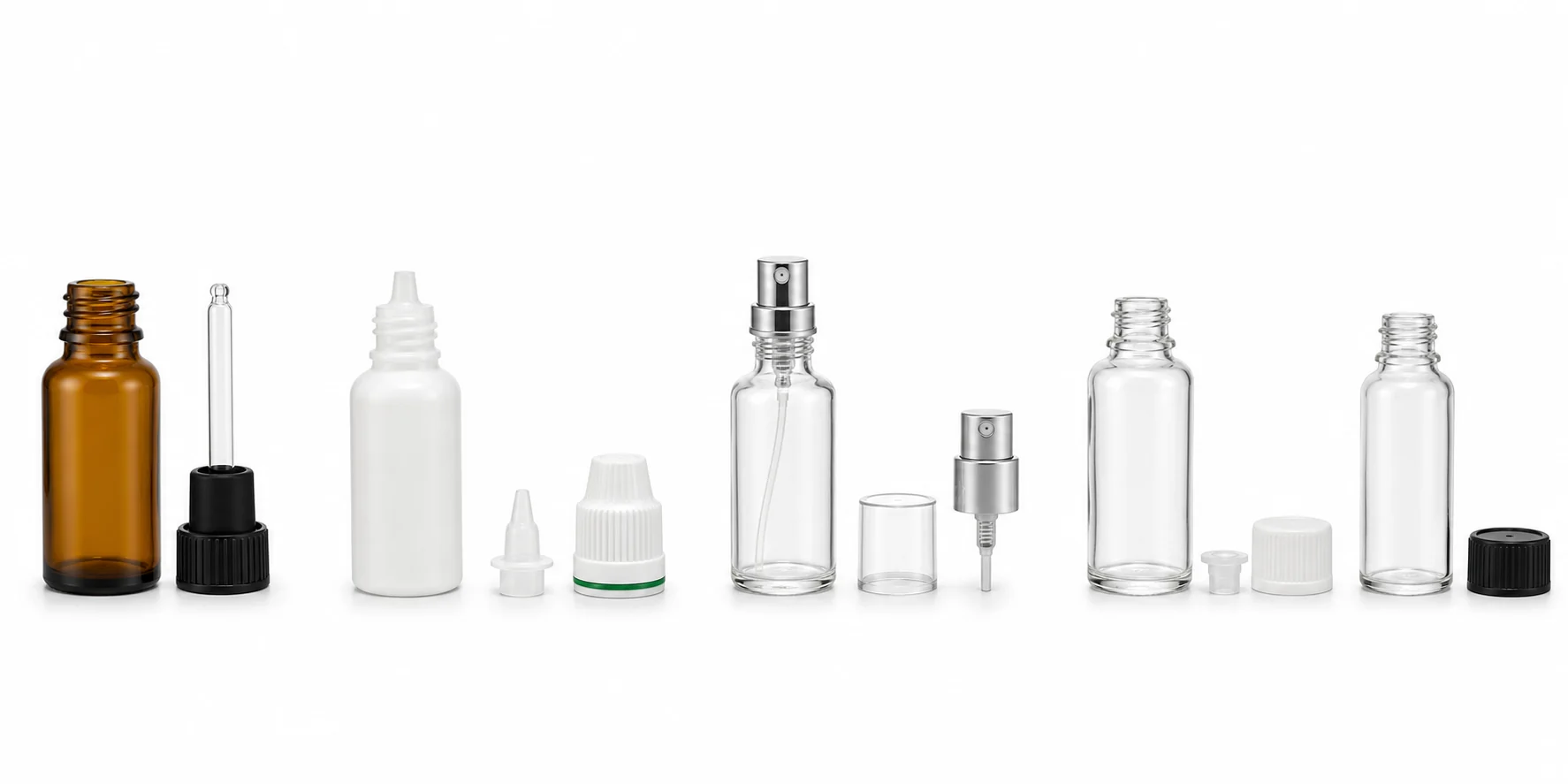
A small bottle filling and capping machine should not be chosen from bottle volume alone. A 2 oz or 4 oz glass bottle with a long dip-tube pump behaves differently from an eye-drop bottle with a nozzle plug, even when both contain a free-flowing liquid. Closure geometry, bottle stability and operator work can limit the line before the filler reaches its advertised speed.
1. Start With the Complete Small-Bottle Package
The same bottle can require a different machine sequence when the closure changes. Write the process from empty bottle to finished package before comparing equipment.
| Package | Typical process questions | Tooling or control to confirm |
|---|---|---|
| 2–4 oz pump bottle | Is the dip tube straight, flexible or curved? Can the pump be presented consistently? | Bottle support, pump orientation, dip-tube insertion, thread start and tightening method. |
| Essential-oil dropper bottle | Is there an orifice reducer, pipette dropper or separate screw collar? | Small-volume dosing, plug insertion force, dropper handling and cap torque. |
| E-liquid bottle | Does the package use a nozzle insert, tamper-evident cap or child-resistant closure? | Nozzle placement, closure-specific tooling and buyer-defined compliance checks. |
| Eye-drop bottle | What nozzle plug and tamper-evident cap are used? What production-area requirements apply? | Plug insertion, cap handling, product-contact design and project-specific regulatory requirements. |
| Fine-mist or fragrance bottle | Must the spray pump and overcap be installed on the same line? | Pump placement, overcap station, container support and leak or actuation checks. |
Use the container and closure information checklist to collect neck-finish drawings, bottle dimensions, component photos and the SKU list. Initial review can start from drawings and dimensions; physical packages are requested later when tooling validation or the factory acceptance test requires them.
2. Choose the Automation Level by Operator Work, Not Only Price
| Line approach | Where it fits | Main limitation to price and test |
|---|---|---|
| Manual filling and capping | Development batches, very low volume or frequent package changes. | Labor, dose consistency, repetitive work and traceable inspection. |
| Semi-automatic filler with manual cap placement | Controlled dosing is needed, but the current output does not justify automatic cap feeding. | Operator balance, cap placement quality and the capper's actual sustained rate. |
| Open small-bottle monoblock | A compact integrated process with direct access for production and changeover. | Required guarding, cap supply, change parts and operator access. |
| Safety-enclosed monoblock | A more controlled automated process around moving filling and closure stations. | Guarding interfaces, access doors, cleaning access and final factory layout. |
Manual cap placement can be a sensible first stage, but the quotation should show the labor it retains. Automatic cap feeding adds more than a hopper: the supplier must prove orientation, transfer, missing-cap detection and recovery from a misfed closure. Long dip tubes, pumps and multi-piece droppers usually require more package-specific testing than simple screw caps.
The semi-automatic versus automatic filling guide helps map every operator touch before deciding which work should be automated.
3. Select the Dosing Method From the Liquid and Dose
Free-flowing essential oils, e-liquid, fragrances and similar products can be evaluated with pump-based or other suitable small-volume dosing methods. Serum and other products may need a different product-contact path or feed arrangement. No dosing principle is automatically correct for every formulation.
ZXSMART's published small bottle filling and capping monoblock lists piston, gear-pump or magnetic-pump configurations. Its published reference configuration has a 50–500 mL filling range, two filling heads, a reference speed of 50 bottles per minute and a stated ±1% accuracy. These are platform references, not a promise for every product or package. The project-specific result must be confirmed with the selected dosing method, actual dose, bottle, closure sequence and test conditions.
4. Treat Pump, Plug and Cap Handling as Separate Engineering Stations
A complete small bottle filling and capping line may need bottle feeding, positioning, filling, inner-plug insertion, outer-cap placement, tightening and inspection. If the package does not use an inner plug, that station can be omitted. If it uses a pump with a dip tube, the cap feeder and insertion path must handle that component without bending, cross-threading or damaging the tube.
Questions for a pump or dropper closure trial
- Can mixed or incorrectly oriented closures enter the feeder?
- How is a long dip tube controlled before it enters the bottle neck?
- How does the machine detect a missing inner plug, pump or outer cap?
- What supports the bottle while the plug is pressed or the cap is tightened?
- How are thread start, final torque and tamper-evident features checked?
- Which parts change when bottle diameter, height, neck finish or closure changes?
For projects using pump heads, also review the pump-head bottle filling and capping line guide and the capping changeover checklist.
5. Plan Growth From 8 to 50 Bottles per Minute With Two Written Scenarios
Do not buy future capacity as a single headline number. Ask for a current scenario and a growth scenario. For each, record the bottle, fill volume, closure, operators, cap-feeding method, sustained finished-bottle rate and downstream equipment.
| Planning item | Current production | Growth production |
|---|---|---|
| Sustained output | Rate required for today's confirmed orders and shift pattern. | Credible rate and SKU mix, not an unsupported maximum. |
| Cap supply | Manual placement may be acceptable if operator work is balanced. | Automatic feeding may be required; validate orientation and refill intervals. |
| Filling and capping stations | Stations sized for the current dose and cycle. | Document whether extra heads, a different feeder or another machine is needed. |
| Downstream process | Collection, inspection or labeling at the present rate. | Confirm the labeler, coder, conveyor and accumulation can sustain the target. |
| Change parts | Only confirmed launch SKUs. | List future bottles and closures that can be added without redesigning the base machine. |
Use the capacity and filling-head calculation guide to convert shift demand into a sustained bottles-per-minute requirement. A reference speed is not the same as accepted output: filling time, closure handling, replenishment, rejected packages and changeovers all affect finished production.
6. Build a Factory Acceptance Test Around Production-Representative Items
- Approve the product or representative test material and record its temperature and behavior.
- Supply every launch bottle, inner plug, dropper, pump, cap and overcap required for the test.
- List each target dose and the measurement method and tolerance used to accept it.
- Run the complete sequence at the agreed sustained rate, not only slow demonstration cycles.
- Check cap orientation, dip-tube insertion, missing-closure detection, cross-threading and final tightening.
- Record startup, normal stop and restart, cap replenishment and recovery from a misfed component.
- Perform the agreed changeover and verify the first acceptable bottles after release.
- Save recipes, measured results, deviations, videos and the approved change-part list.
The ZXSMART factory acceptance process provides the project framework. Buyers with pharmaceutical, eye-drop or other regulated applications must define their own sanitary, cleanroom, validation and regulatory requirements in the user requirement specification; those requirements are not assumed from the machine name.
7. Small Bottle Filling and Capping Line Quotation Checklist
- Product name, behavior, filling temperature and contact-material requirements.
- Every fill volume, bottle drawing and bottle stability condition.
- Inner plug, dropper, pump, cap and overcap drawings, samples and orientation requirements.
- Current and future sustained output, shift pattern and expected SKU mix.
- Manual versus automatic bottle, cap and closure feeding scope.
- Required inspections, rejection logic, guarding and operator access.
- Change parts, expected changeover method, cleaning method and retained-product limits.
- Factory voltage, compressed air, available footprint and upstream/downstream interfaces.
- Factory acceptance material quantities, test duration, pass rules and documentation.
- Installation, training, spare parts, service language and response scope.
Define Your Small-Bottle Line Before Quotation
Send product details, 2 oz, 4 oz or other target volumes, bottle dimensions, pump or closure drawings, sustained output, utilities and layout. ZXSMART will review the required filling and closure sequence and identify which physical items are needed later for tooling and FAT.
Send Bottle and Closure Details8. Buyer FAQ
What machine is suitable for filling 2 oz and 4 oz bottles?
Start with product behavior, dose range, bottle stability and the complete closure sequence. For a compatible free-flowing product with a pump, dropper, nozzle plug or screw cap, a small-bottle monoblock can combine dosing and closure operations after the actual package is confirmed.
Should small bottle caps be placed manually or fed automatically?
Manual placement can reduce initial automation cost at low output, but it retains operator labor and cap-orientation risk. Automatic feeding is easier to justify when the closure is stable, sustained output is high enough and production closures pass a feeder trial.
Can one machine fill essential oil, e-liquid, eye drops and serum?
One platform may be configurable for several small-bottle products, but the product-contact path, dosing method, sanitation requirement, bottle neck, plug, pump and cap tooling must be confirmed for every SKU. Regulated production requirements remain project-specific.
How do I plan for growth from 8 to 50 bottles per minute?
Write separate current and growth scenarios. Ask which filling stations, cap-feeding method, operators, change parts and downstream machines are required at each rate, then test the selected configuration at the agreed sustained output.
What should I send before requesting a quotation?
Send product details, every target dose, bottle drawings and dimensions, closure component photos or drawings, sustained output, changeover list, utilities and layout. Physical bottles, closures and product can be requested later for tooling or factory acceptance testing.
Research Notes
Public Reddit discussions were used to identify buyer language around 2–4 oz pump bottles, moving from hand work to automation, manual versus automatic cap placement, current versus future bottles-per-minute requirements, budget, local service, user requirements, changeover and representative test material. These discussions are question signals only, not ZXSMART customer cases, performance evidence or endorsements.